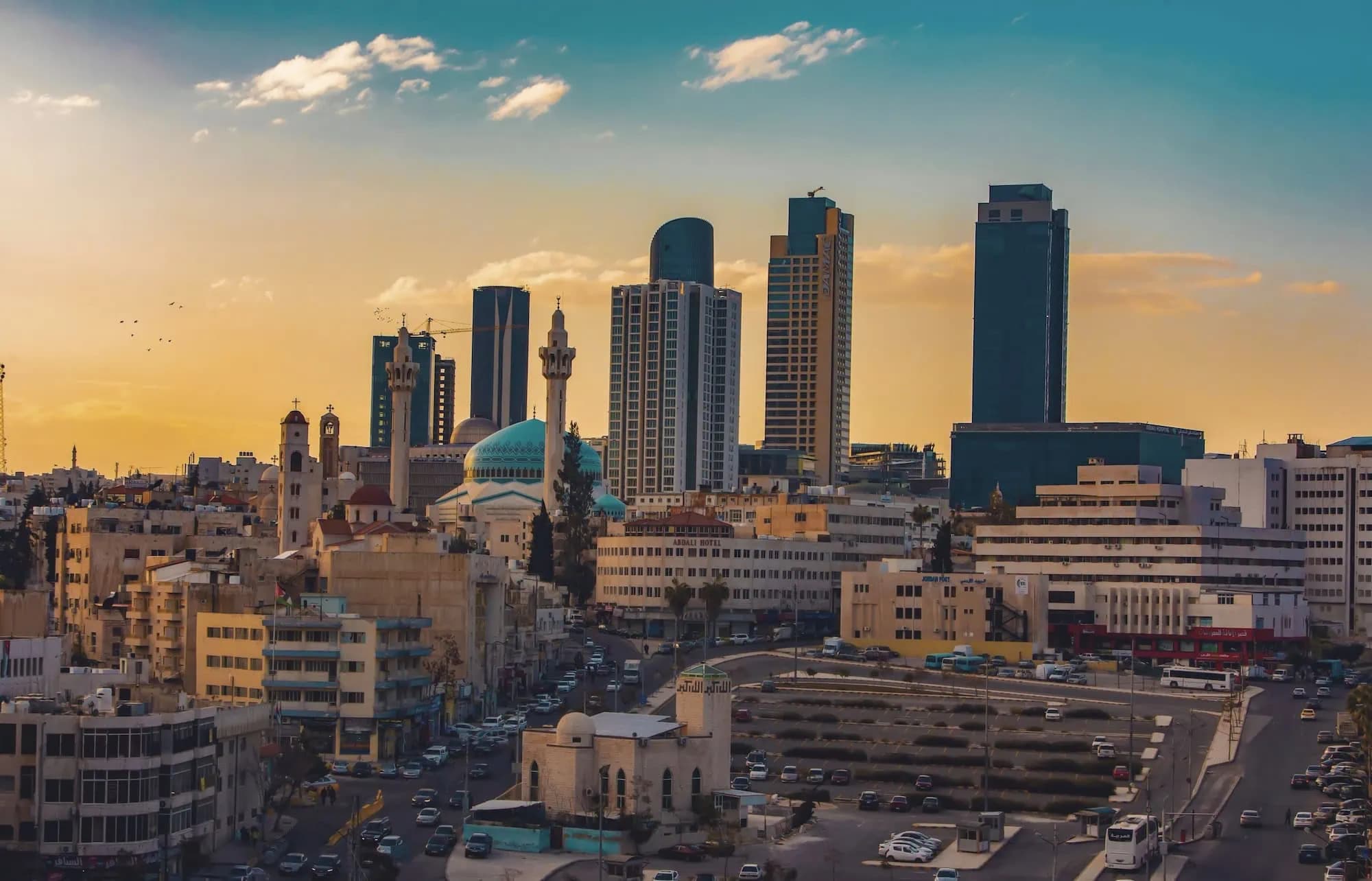
Jordan is a prime investment destination for foreigners due to the incentives it offers and the diverse range of regions that provide numerous advantages. Overall, its moderate level of competitiveness compared to other countries in the region creates high-value opportunities, making Jordan a suitable choice for foreign investment.
In this guide, we will present the best real estate investment areas for expatriates in Jordan, in addition to the advantages of each area, and the nature of the appropriate investment.
The Best Investment Areas for Expats
Amman the Capital
Amman occupies a unique position in the investment world, unrivaled by any other city in Jordan. It accounts for the largest share of buying, selling, and renting activity and boasts the most diverse and valuable projects.
The upscale western neighborhoods, such as Abdoun, Rabieh, and Umm Uthaina, are at the forefront of demand among foreign investors. They combine comprehensive services, international schools, restaurants, and medical centers, making them ideal for long-term rentals, particularly for diplomats and employees of international organizations. Luxury apartments in these neighborhoods range in price from 150,000 to 400,000 Jordanian dinars, depending on size and finishing, while detached villas can far exceed this.
In contrast, neighborhoods like Jubaiha, Abu Nseir, and Khalda offer a different investment model, focusing on mid-range apartments aimed at students, employees, and young families. Entry costs in these areas are more modest, and rental returns are more consistent thanks to steady demand. As for the Al-Abdali and Al-Bunayyat areas, they are witnessing an increase in the percentage of commercial and administrative projects targeting companies, offices and medical clinics.
Aqaba: Jordan's Tourist City
If there is one Jordanian city specifically designed to attract foreign investors, it is undoubtedly Aqaba. The city operates as a special economic zone under the independent authority of the Aqaba Special Economic Zone Authority (ASEZA), and enjoys a wide range of exemptions, including sales tax, customs duties, and personal income tax on many activities.
Investment in Aqaba is concentrated around two main axes: the first is the tourism sector, encompassing hotels, resorts, beachfront chalets, restaurants, and marinas, as the marine environment, coral reefs, and diving are genuine global attractions. The second is luxury residential developments overlooking the Red Sea, whether in integrated residential complexes or apartments in modern high-rise towers.
It is worth noting that property registration procedures in Aqaba are more flexible and faster compared to other governorates, making it a preferred destination for those seeking a minimally regulated investment experience.
The Dead Sea: A Tourism and Wellness Investment Opportunity
The Dead Sea region stands in a completely different category from Amman and Aqaba. It is not a city in the traditional sense, but rather a tourism and wellness destination whose investment value stems from its unique geographical location.
The lowest point in the world, its richness in therapeutic minerals and salts, and its year-round warm, dry climate all contribute to making the region a perennial destination for health and wellness tourism from around the globe.
Investment here focuses primarily on health resorts, spas, luxury hotels, and eco-friendly chalets. The region has attracted major international hotel chains that operate with remarkable success, encouraging new investors to follow suit with similar models.
Irbid and Zarqa: A Simple Investment with Real Returns
Many foreign investors overlook the cities of Irbid and Zarqa, which present an opportunity for those seeking less saturated markets. Irbid is Jordan's second-largest city by population and is home to Yarmouk University and several other academic institutions, generating consistent annual rental demand from students, their families, and faculty. Zarqa, on the other hand, is a densely populated industrial city, resulting in continuous pressure on affordable housing units and regular rental income.
A key advantage of these two cities is their significantly lower acquisition prices compared to Amman. You can find a suitable apartment for less than half the price of a similar property in the western neighborhoods of the capital. For those who prefer a long-term rental model with a stable environment and genuine demand, these two cities are well worth considering.
The Area | Investment Type | Price per square meter | Liquidity | Who is it suitable for? |
Western Amman | Residential — commercial | 1,200 - 2,500 | High | Investor seeking capital value |
Eastren Amman | Residential | 600 - 1,100 | Mid | Investor seeking constant rental income |
Aqaba | Tourist — Residential Seaside | 900 - 2,000 | Mid | Investor in tourism and accommodation |
Dead Sea | Tourist - Hotels | 2,000 | Mid | Resorts investor |
Irbid & Zarqa | Affordable residential | 450 - 700 | Low | Investor with limited capital |
Investment Types in Jordan
Investment types in Jordan vary according to the desired investment goal, and include the following types:
1. Residential Investment
This is the most popular type of investment in Jordan, involving the purchase of apartments, villas, and land for the purpose of renting or reselling when values increase.
2. Commercial Investment
This includes retail shops, offices, medical clinics, warehouses, and shopping malls. It is primarily concentrated in Amman, Sahab, and Aqaba, and is characterized by longer lease terms and more stable returns; however, it requires more active monitoring from the investor.
3. Tourism investment
Concentrated in Aqaba, the Dead Sea, and the Petra area, benefiting from government incentives offered to hospitality projects. This sector offers high returns during peak tourist seasons, but it is heavily dependent on the influx of international tourists.